



Crypto Wallet for Buying Gold & Wallet Hygiene
When you buy gold or silver with Bitcoin or other cryptocurrencies, your wallet choice and
Shop Online 7:00 AM–8:00 PM PST Mon-Sun
FREE Insured Shipping
(307) 201-3513 Text or Call Mon-Fri
This article is for informational and educational purposes only and does not constitute financial, investment, legal, or tax advice.
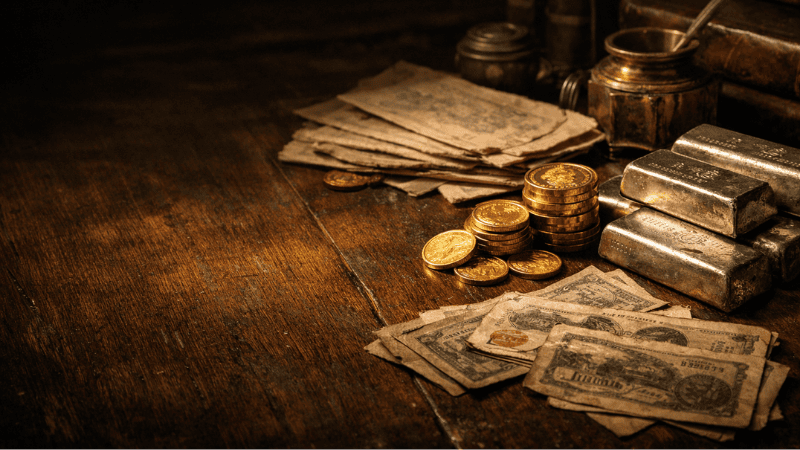
Throughout history, financial systems have changed again and again. Empires have risen and fallen, currencies have been created and destroyed, and entire economies have been reshaped by inflation, war, and political upheaval. Yet through all of that disruption, gold and silver have remained recognizable forms of wealth. Long before modern banking, long before digital finance, and long before central banks managed paper currencies, precious metals were already trusted as stores of value.
That long history still matters. Precious metals through inflation war and currency change is not just a historical theme. It is a reminder that while governments, monetary systems, and financial instruments evolve, some assets continue to hold relevance across very different eras. Gold and silver are not important because they are fashionable. They are important because they have repeatedly remained valuable when trust in other forms of money has weakened.
One of crypto’s biggest contributions has been cultural as much as financial. It forced a generation of invesGold and silver have been used as money, savings, and stores of wealth for thousands of years. That endurance is not an accident. These metals possess qualities that made them useful long before modern economics gave those qualities names. They are scarce, durable, divisible, portable, and widely recognized. They do not rot, corrode easily, or depend on an institution’s promise to retain value.
Those qualities made precious metals especially important in times of uncertainty. When confidence in paper claims weakened, physical metals often remained understandable and trusted. A gold coin did not require faith in a central bank. A silver coin did not depend on a government maintaining discipline over the money supply. Even when political systems changed, the underlying metal still retained value because people across cultures already understood its worth.tors to think more carefully about direct ownership. Instead of assuming that an account balance always equals control, many people began to understand the difference between holding an asset yourself and relying on an intermediary. That awareness has been healthy.
Precious metals through inflation war and currency change have repeatedly served as anchors when monetary systems became strained. Inflation erodes purchasing power, war disrupts normal commerce, and currency change can wipe out the reliability of savings held in paper form. In each of these settings, gold and silver have often remained relevant because they exist outside the promises of any single issuer.
This does not mean precious metals are immune to price fluctuations. Their market prices can and do move. However, their deeper role has often been different from the role of fiat currency or speculative assets. They have served as tools of continuity. When the unit of account changes, when confidence in state-issued money falls, or when political disorder makes paper claims less reliable, physical precious metals can still represent real, transferable wealth.
Inflation is one of the clearest reasons people return to hard assets. When a currency loses purchasing power steadily, savers begin to feel the difference even if the change appears gradual at first. Everyday goods cost more, financial planning becomes more difficult, and money held in cash becomes less effective as a store of value. In such environments, people often start asking whether their currency is truly preserving wealth or simply leaking value over time.
Gold and silver have historically attracted interest in inflationary periods because they are limited physical assets. They cannot be created at will in the same way that paper currency or digital bank reserves can be expanded. While precious metals do not always rise in a perfectly straight line during inflationary periods, they have long been associated with a different monetary logic. They represent scarcity, while inflation often reflects expanding supply of money and credit. That contrast helps explain why precious metals continue to hold psychological and practical appeal whenever inflation becomes a central public concern.
War does not only destroy infrastructure and redraw maps. It also disrupts trade, weakens institutions, strains public finances, and often reshapes the monetary order. Governments at war may borrow heavily, debase currency, suspend convertibility, impose controls, or redirect economic activity toward survival and military necessity. In those conditions, confidence in ordinary financial arrangements can deteriorate rapidly.
Throughout history, portable stores of value have mattered during conflict because stability becomes more important when systems are under stress. Gold and silver are compact, widely recognized, and historically exchangeable in ways that many other assets are not. Real estate may be immovable. Business ownership may become impaired. Paper claims may depend on institutions that are no longer functioning normally. Physical precious metals, while not solving every problem, have often been valued precisely because they remain tangible and transferable under conditions where many forms of wealth become harder to protect.
One of the least appreciated risks in financial history is currency change itself. A government can redenominate a currency, replace notes, devalue the old unit, or move from one monetary regime to another. Even when these transitions are orderly, they can alter the real value of savings. In more chaotic cases, they can destroy it.
This is where the historical role of precious metals becomes especially important. Gold and silver are not tied to one national currency or one policy framework. They can be priced in dollars, euros, pounds, or other currencies, but they are not created by those systems. That distinction matters. If a paper currency changes, the gold coin does not become a different metal. If a monetary regime shifts, the silver bar does not lose its physical identity. This independence from any single currency system is one reason precious metals have remained important across centuries of monetary transition.
Modern investors sometimes assume that because financial systems are more sophisticated today, the lessons of older monetary history are less relevant. In reality, technology changes much faster than human behavior. Governments still face fiscal pressure. Central banks still make difficult trade-offs. Markets still swing between confidence and fear. Political instability still affects money. The forms may look more modern, but the underlying pressures are familiar.
Historical memory matters because it reminds us that monetary credibility is not guaranteed forever. A stable currency can become unstable. A trusted institution can lose confidence. A widely accepted system can weaken under enough pressure. Gold and silver remain relevant in part because they have already lived through these cycles before. They are not theoretical hedges created for a modern portfolio model. They are assets with a long record of retaining meaning when other financial arrangements are changing.
It is important not to reduce the role of precious metals to catastrophe alone. Gold and silver are not only for collapse scenarios. They are also part of a broader philosophy of diversification, prudence, and long-term thinking. People buy precious metals not only because they expect disaster, but because they understand that economic conditions can shift gradually and unpredictably. Inflation can build over time. Currency weakness can emerge slowly. Financial repression can arrive in small steps rather than dramatic headlines.
That is why precious metals often appeal to disciplined, long-term buyers. They are not necessarily chasing the fastest gains. Instead, they are allocating part of their wealth into assets with deep history, physical reality, and broad recognition. In that sense, precious metals can function as financial ballast. They may not always be the most exciting assets in a portfolio, but their value often lies in their durability rather than their novelty.
Although gold and silver are often grouped together, they can serve different buyer needs. Gold is usually seen as the more concentrated store of value. It is compact, highly liquid, and historically associated with reserve-like wealth preservation. Silver, on the other hand, offers a lower entry point and has historically played a stronger role in everyday circulation and smaller-denomination trade.
That difference can matter when investors think about resilience. Gold may appeal more to those seeking a high-value asset in a compact form, while silver may appeal to those who want affordability, divisibility, and broader flexibility. Both metals share the underlying advantage of being physical hard assets, but each has its own character. Understanding that distinction helps buyers think more clearly about why they own precious metals in the first place.
Today’s investors live in a world of digital accounts, central bank policy shifts, market volatility, and geopolitical uncertainty. Most people will not experience currency collapse in a dramatic historical sense, but that does not mean the underlying lessons are irrelevant. Even moderate inflation can alter financial outcomes over time. Policy shifts can affect purchasing power. Periods of conflict can destabilize confidence. Currency systems can weaken slowly before the broader public fully notices.
For modern buyers, the lesson is not to panic. It is to think clearly about what kinds of assets endure under different conditions. Precious metals remain relevant because they are tangible, widely understood, and not dependent on the solvency or promises of a single institution. They can still play a role in preserving purchasing power, diversifying risk, and anchoring part of a long-term wealth strategy.
Inflation, war, and currency change have shaped financial history again and again. Through those changes, gold and silver have remained durable symbols and instruments of real wealth. Their value has never depended entirely on a specific government, a single monetary policy, or the continued credibility of paper currency. That is a rare quality, and it helps explain why precious metals still matter.
For buyers who think beyond the next quarter or the next market cycle, precious metals offer something deeper than short-term price action. They offer continuity. They represent a form of wealth that has endured through changing systems, political pressure, and monetary disruption. That is why they continue to deserve attention today.
Precious metals have held value through inflation and war because they are scarce, durable, portable, and widely recognized. Unlike paper currencies, they do not depend entirely on government promises or monetary policy.
Not always in a straight line. However, gold and silver have historically attracted interest during inflationary periods because they are physical hard assets with limited supply.
Precious metals matter during currency change because they are not tied to one specific paper currency. They can retain value even when monetary systems are restructured or confidence in a currency weakens.
No. Precious metals are also used for diversification, long-term wealth preservation, and reducing dependence on purely financial assets.
Gold is often preferred for concentrated wealth preservation because it stores high value in a compact form. Silver can also play an important role, especially for buyers who want a lower entry point and more divisibility.

JAMES HARGROVE - Precious Metals Specialist
James brings over 14 years of experience in the precious metals industry, specializing in gold and silver bullion markets. He has an in-depth knowledge of market pricing, coin grading, and the factors that drive spot price movements. James advises Veldt’s customers on building a balanced physical metals portfolio and ensures every transaction reflects fair, real-time market value. When he’s not analyzing the markets, he is an avid collector of rare pre-1933 U.S. gold coins.
VELDT
861 6th Ave #504
San Diego, CA 92101
By Appointment Only. Contact us to make an appointment.
When you buy gold or silver with Bitcoin or other cryptocurrencies, your wallet choice and

Silver is one of the most accessible precious metals, but the type of product you

Disclaimer: This article is for educational purposes only. It is not tax advice. Always consult
If you’re considering buying precious metals, you’ve likely heard the terms bullion vs numismatics. While
|
Gold: 4,785.62 | Silver: 78.59 | Platinum: 2,072.73 | Palladium: 1,533.06 |