

Silver Dimes Years: What Year Dimes Are Silver?
Learn which silver dime years to look for, why 1964 and earlier U.S. dimes matter, and how old silver dimes can be worth more than
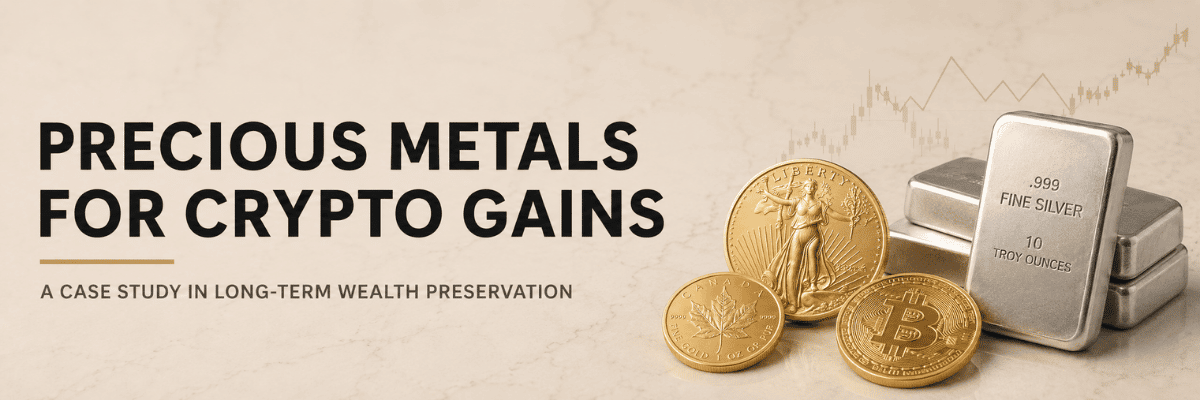
Crypto traders can use precious metals to preserve gains by converting part of their profits into physical gold and silver. This approach may help reduce exposure to crypto volatility while creating a tangible long-term wealth reserve outside digital markets.
This case study is a hypothetical educational example. It is not financial, tax, legal, or investment advice.
Cryptocurrency trading can create life-changing gains, but those gains can disappear quickly when markets reverse. Many traders focus intensely on entries, exits, technical setups, and token narratives. However, the harder question often comes after a winning trade: what should you do with the profit?
This case study explores how a crypto trader could use precious metals for crypto trading gains by converting a portion of digital profits into physical gold and silver. The goal is not to abandon crypto. Instead, the goal is to build a more durable long-term strategy that balances upside potential with tangible wealth preservation.
For traders who already understand self-custody, limited supply, and financial independence, physical bullion can feel like a natural extension of the same mindset. Bitcoin and gold are different assets, but both appeal to people who want options outside traditional banking and currency systems.
Imagine a trader named Daniel. He started buying Bitcoin and other digital assets during a quiet period in the market. Over time, he became more active. He learned how narratives move, how liquidity affects price, and how quickly fear and greed can change the market.
During a strong crypto cycle, Daniel’s portfolio grew fast. Some gains came from long-term Bitcoin exposure. Other gains came from shorter trades in higher-risk assets. For a while, everything seemed to work. The problem was that nearly all of his wealth remained tied to the same volatile ecosystem.
He had profits on paper, but little had been converted into anything outside crypto. When the market pulled back, he realized that a winning trade only becomes a real long-term advantage when some of the gain is protected.
Crypto markets can move with unusual speed. A trader may feel wealthy during a rally, then watch months of gains disappear in a few days. This does not mean crypto is bad. It means risk management matters.
Daniel’s issue was not that he believed in digital assets too much. His issue was that he had no system for harvesting profits. He would sell one coin into another, move into stablecoins temporarily, or wait for the next setup. Yet his wealth still remained inside a digital trading environment.
That created several risks. Exchange risk, wallet risk, smart contract risk, market risk, and emotional risk all remained part of the picture. Even when he was “out of the trade,” he was still thinking like a trader instead of a long-term wealth builder.
Daniel decided to create a simple rule. Every time his crypto portfolio reached a new profit milestone, he would convert a percentage of the gain into physical precious metals. He did not sell everything. He did not stop trading. He simply created a habit of moving some value from a volatile digital asset class into tangible gold and silver.
The purpose of this approach was psychological and practical. Once he bought bullion, that portion of the gain was no longer just a number on a screen. It became metal he could store, track, insure, pass down, or sell later if needed.
For Daniel, this changed the way he viewed trading. Instead of chasing every move, he began treating crypto as a wealth-generation engine and precious metals as part of his long-term wealth-preservation layer.
Gold and silver gave Daniel something crypto could not: physical finality. A gold coin or silver bar does not depend on an app, exchange account, password manager, or blockchain connection to exist. That does not make it better than crypto in every way, but it does make it different.
Gold appealed to him because it stores significant value in a compact form. Silver appealed to him because it offered a lower entry point and allowed him to build ounces gradually. Together, they gave him a tangible reserve that felt separate from the emotional swings of crypto trading.
He also began comparing bullion pricing against published precious metals price data so he could better understand spot price, premiums, and the difference between paper market pricing and physical product pricing.
Daniel’s rule was intentionally simple. When he closed a profitable trade or his portfolio reached a major milestone, he moved a set percentage of the profit into physical metals. The percentage changed depending on market conditions, tax planning, and cash needs, but the principle stayed the same.
He treated gold as the core preservation asset and silver as the accumulation asset. Gold helped him store larger value in less space. Silver gave him flexibility and a way to keep building physical ounces without needing every purchase to be large.
This rule helped remove emotion from the decision. Instead of asking, “Should I sell now?” during every rally, he had a process. When profits reached a target, some of the gain left the trading environment and moved into a physical reserve.
Daniel started with products that were easy to understand. For gold, he focused on recognizable bullion coins and bars from reputable sources. For silver, he looked at one-ounce rounds, ten-ounce bars, and widely recognized silver coins.
He avoided complicated collectibles at first. Rare coins, proof sets, limited-edition products, and high-premium items required more knowledge than he wanted to manage. His goal was not to become a numismatics expert. His goal was to preserve a portion of trading profits in liquid, recognizable metal.
That simple product selection made the process easier. He could compare prices, understand premiums, and build a position without wondering whether he was paying for collector value he did not fully understand.
One of Daniel’s frustrations was moving between crypto, bank accounts, and physical assets. Traditional payment methods worked, but they sometimes felt disconnected from the way his gains were created. Buying metals with crypto made the transition from digital profit to physical bullion feel more direct.
At Veldt, customers can buy gold, silver, platinum, and palladium with supported cryptocurrencies through secure crypto checkout. Supported payment options include BTC, LTC, ETH, DOGE, USDT, USDC, XMR, and XRP.
For traders like Daniel, that matters because the process matches the source of funds. Instead of thinking only in dollars, he could think in terms of converting a portion of digital gains into tangible assets while keeping the transaction straightforward.
The biggest benefit was not that Daniel perfectly timed every market. He did not. He still had winning trades and losing trades. He still watched crypto markets swing violently. The difference was that some of his past wins were now outside the cycle.
When the market corrected, he had less regret because he had already converted part of his gains into physical metal. When the market rallied again, he stayed involved because he still held crypto exposure. The strategy gave him a middle path between selling everything too early and holding everything through every crash.
Over time, his metals position became a record of discipline. Each coin or bar represented a decision to keep some profit instead of risking all of it in the next trade.
This strategy is not perfect. Precious metals can move down in price. Physical bullion has premiums, spreads, storage needs, and security considerations. A trader also needs to consider taxes, records, and the difference between a trading decision and a long-term savings decision.
There is also an opportunity cost. Money moved into gold and silver is no longer available for the next crypto trade. For some traders, that feels limiting. For others, that is exactly the point. A profit-taking rule only works if some money actually leaves the risk environment.
Daniel accepted the tradeoff because he did not want every dollar of his net worth tied to the next market cycle. He wanted crypto upside, but he also wanted a physical reserve that could survive outside the exchange, wallet, and trading screen.
The first lesson is that profit needs a destination. If every gain stays inside the same market, the trader remains exposed to the same emotional and financial risks. Moving part of a gain into gold and silver can create separation.
The second lesson is that simplicity helps. Daniel did not start with complicated products. He focused on recognizable bullion, clear pricing, and a repeatable process. That made the strategy easier to follow during both bull markets and corrections.
The third lesson is that wealth preservation is not the same as market timing. Precious metals did not need to outperform every crypto asset to be useful. Their role was to preserve some value, reduce concentration, and create a tangible reserve.
A trader who wants to apply this idea could start by setting a simple profit-taking rule. For example, after a major portfolio milestone or profitable trade, a set portion of the gain could be moved into physical gold or silver.
The next step is choosing products that match the goal. Gold may fit compact long-term storage. Silver may fit gradual accumulation and smaller purchases. A mix of coins, bars, and rounds can work, but beginners should avoid products they do not understand.
Finally, the trader should store and document the metals carefully. Physical ownership comes with responsibility. Receipts, product details, secure storage, and a clear plan matter just as much as the original purchase.
Crypto trading can create powerful opportunities, but gains are only useful if some of them survive the cycle. For traders who want a more balanced long-term approach, physical gold and silver can provide a tangible place to preserve part of the upside.
The point is not to choose between crypto and precious metals. The point is to use each for what it does best. Crypto can offer growth, liquidity, and asymmetric upside. Gold and silver can offer physical ownership, long-term recognition, and a wealth-preservation layer outside digital markets.
At Veldt, customers can use secure crypto checkout to buy gold, silver, platinum, and palladium with supported cryptocurrencies. For traders looking to convert part of their crypto profits into gold and silver, precious metals can become a practical bridge between digital opportunity and long-term wealth preservation.
Yes. Crypto traders can convert part of their profits into physical gold and silver to reduce exposure to crypto volatility and build a tangible long-term wealth reserve.
A crypto trader may buy gold or silver to diversify outside digital markets, preserve profits, reduce emotional trading pressure, and hold a physical asset with long-term recognition.
Not necessarily. Many traders use precious metals as part of a balanced strategy rather than replacing crypto entirely. The right allocation depends on risk tolerance, goals, taxes, and personal financial circumstances.
Yes. Veldt allows customers to buy gold, silver, platinum, and palladium with supported cryptocurrencies through secure crypto checkout.
No. Precious metals can move down in price and may involve premiums, spreads, storage, and security considerations. They can support wealth preservation, but they are not risk-free.
Learn which silver dime years to look for, why 1964 and earlier U.S. dimes matter, and how old silver dimes can be worth more than

A practical case study on how a crypto trader could use precious metals to preserve gains, reduce volatility exposure, and build long-term wealth outside digital

Learn how to store silver coins and bullion safely, including tips for handling, organizing, documenting, and protecting silver at home or in secure storage.

Compare silver bars and silver coins so you can understand premiums, storage, resale, liquidity, and which silver option may fit your buying goals.
Now that you understand more about precious metals, Veldt can help you take the next step. Buy gold and silver online, use supported cryptocurrencies at secure checkout, or contact us for local help choosing the right bullion for your goals.
|
Gold: 4,540.58 | Silver: 75.98 | Platinum: 1,977.05 | Palladium: 1,408.42
|