

How To Store Silver Coins And Bullion Safely
Learn how to store silver coins and bullion safely, including tips for handling, organizing, documenting, and protecting silver at home or in secure storage.
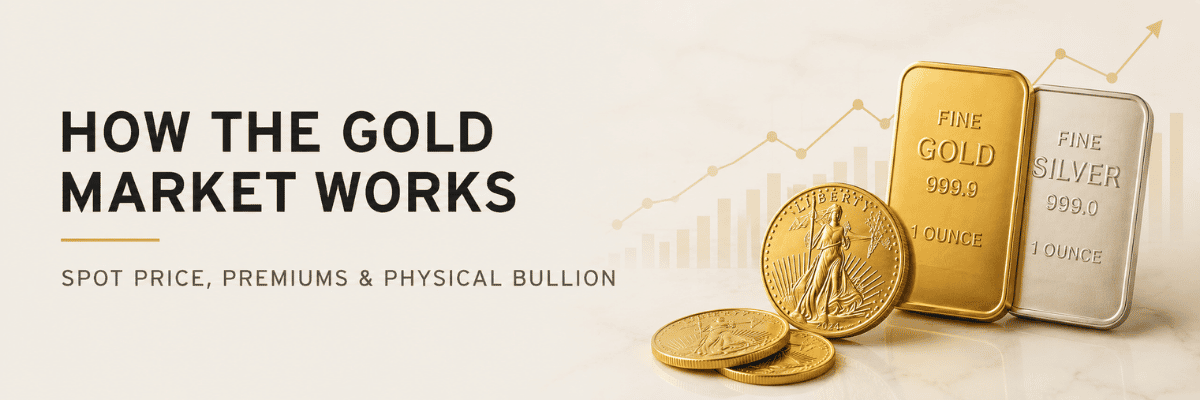
The gold market works through a global network of spot markets, futures contracts, refiners, wholesalers, dealers, and buyers. The spot price reflects the current wholesale value of gold, while physical bullion prices include premiums for minting, distribution, demand, dealer margin, shipping, and product type.
Understanding how the gold market works can help you make better decisions when buying physical bullion. Many new buyers see the gold spot price online and assume that is the exact price they should pay for a coin or bar. In reality, the gold market has several layers. The price you see quoted on financial websites is only the starting point.
Gold trades globally through large institutions, banks, refiners, futures exchanges, wholesalers, dealers, and retail buyers. The headline price usually reflects the wholesale market for gold, not the final retail price of a specific gold coin or bar delivered to your door. Once you add product premiums, supply conditions, payment method, shipping, insurance, and dealer margin, the final price can be higher than spot.
That does not mean the physical gold market is confusing or unfair. It simply means bullion buyers need to understand the difference between paper pricing and physical ownership. When you know how spot price, premiums, and liquidity work together, you can compare products more intelligently and avoid common mistakes.
The gold market is the global system where gold is bought, sold, priced, refined, stored, hedged, and delivered. It includes central banks, large financial institutions, mining companies, refiners, mints, wholesalers, bullion dealers, investors, jewelers, and private buyers.
Unlike a single stock that trades on one main exchange, gold trades around the world nearly continuously during the business week. Prices respond to global demand, currency movements, interest rates, inflation expectations, geopolitical risk, central bank activity, and investor sentiment.
Physical gold also has a real supply chain. Gold may move from mines to refiners, then to mints or fabricators, then to wholesalers, dealers, and end buyers. Every step can affect availability and cost. That is why the retail price of a gold coin can move differently from the spot price during periods of high demand or tight inventory.
The gold spot price is the current market price for gold in the wholesale market. It is usually quoted per troy ounce and acts as the baseline reference point for bullion pricing.
When people say “gold is up today” or “gold is trading at a certain price,” they are usually talking about spot price or a closely related futures price. This number is useful because it gives buyers and sellers a common reference. However, spot price does not mean you can always buy a finished retail gold product at exactly that amount.
Spot price reflects raw gold value, not the finished cost of a specific coin or bar. A recognized gold coin from a sovereign mint, a sealed gold bar from a respected refiner, or a fractional gold product will usually trade above spot because it includes additional costs and market demand.
Physical gold usually sells for more than spot because finished bullion products require manufacturing, distribution, verification, inventory risk, and dealer service. This extra amount is called the premium.
A premium can include minting costs, refinery costs, wholesale spread, dealer margin, payment processing, market demand, product scarcity, packaging, and handling. Some products have consistently higher premiums because buyers value their recognition, design, or liquidity. Others trade closer to spot because they are larger, simpler, or less expensive to produce per ounce.
For example, a widely recognized gold coin may cost more than a generic gold bar. A fractional gold coin may cost more per ounce than a 1 oz coin because smaller pieces require more manufacturing relative to their gold content. A larger gold bar may carry a lower premium per ounce but may be less flexible to sell later.
This is why buyers should not judge a product only by its total price. They should ask what they are getting for the premium: recognition, liquidity, convenience, divisibility, purity, or lower cost per ounce.
The spot price represents gold’s current market value, while futures contracts represent agreements to buy or sell gold at a future date. Futures markets can influence the price many people see quoted online because they are highly liquid and actively traded.
For most physical gold buyers, the practical lesson is simple. Spot and futures prices help set the benchmark, but they are not the same as retail bullion pricing. A futures contract is a financial market instrument. A gold coin in your hand is a physical product with manufacturing, logistics, and resale considerations.
This difference matters during volatile markets. The paper price of gold may move quickly, while physical premiums can widen if retail demand spikes or supply chains tighten. In calm markets, premiums may be lower and more predictable. In stressful markets, popular products can sell out or trade at higher premiums even if the spot price does not fully reflect that pressure.
Gold prices can move for many reasons. Inflation concerns often increase interest in gold because buyers view it as a long-term store of value. Currency weakness can also support gold because gold is commonly priced in U.S. dollars. When the dollar weakens, gold may become more attractive to global buyers.
Interest rates matter as well. Gold does not pay interest, so higher real interest rates can make cash or bonds more attractive. Lower real rates can make gold more appealing. Geopolitical uncertainty can also drive demand as investors look for assets outside traditional financial systems.
Central banks are another major factor. When central banks buy or sell gold, it can influence market sentiment and long-term demand. Jewelry demand, industrial use, investment flows, mining supply, and recycling all play a role too.
No single factor controls gold all the time. The gold market works through a mix of monetary, political, industrial, and emotional forces. That is why gold can rise during one crisis, pause during another, and behave differently depending on the broader environment.
Bullion dealers usually start with the live market price, then add a product-specific premium. The final retail price depends on the product, quantity, payment method, market conditions, and dealer inventory.
A 1 oz gold bar may have a lower premium than a popular government-minted coin. A Canadian Maple Leaf may price differently from an American Gold Eagle. A larger bar may offer better cost efficiency, while smaller products may offer better flexibility.
Dealers also manage risk. Gold prices move constantly, and dealers must hedge inventory, source replacement products, cover operating costs, and maintain enough margin to stay in business. Reputable dealers price transparently and update pricing as the market moves.
For buyers, the goal is not always to find the absolute cheapest product. The goal is to find a fair price on a recognizable product that fits your plan. A slightly higher premium may be reasonable if the product is easier to sell, easier to verify, or better suited to your storage strategy.
The ask price is what a dealer charges when selling gold. The bid price is what a dealer offers when buying gold back. The difference between the two is called the spread.
Understanding the spread helps buyers think about liquidity. If you buy a gold product at a high premium and later sell it into a weak market, you may need the gold price to rise before you break even. This is why premium awareness matters.
The spread is not necessarily a problem. Every market has a buy-sell difference. But buyers should understand that gold is usually best viewed as a medium- to long-term store of value, not a short-term flip. The more you reduce unnecessary premiums and choose liquid products, the easier it may be to exit efficiently later.
Crypto buyers often approach gold differently from traditional investors. Many are already familiar with self-custody, private wallets, decentralized money, and the risks of keeping wealth entirely on platforms. For that reason, physical gold can feel like a natural companion asset.
At Veldt, customers can buy qualifying precious metals using common cryptocurrencies, including BTC, LTC, ETH, DOGE, USDT, USDC, XMR, and XRP. A crypto holder may use gold to diversify out of digital assets, lock in gains, or build a physical reserve outside an exchange account.
When using crypto to buy gold, buyers should still compare premiums, choose recognizable products, and keep records. Paying with Bitcoin, Monero, stablecoins, or another supported cryptocurrency changes the payment method, but the core bullion principles remain the same. Product recognition, fair pricing, secure checkout, and responsible storage still matter.
The best way to approach the gold market is to focus on your goal first. Are you buying for long-term savings, emergency liquidity, portfolio diversification, privacy, inflation protection, or generational wealth? The answer affects which products make sense.
If you want flexibility, smaller coins and bars may be better. If you want lower premiums, larger bars may make sense. If you want maximum recognition in the United States, American Gold Eagles may be attractive. If you want high-purity sovereign coins, Canadian Maple Leafs may be a strong choice.
Avoid buying only because gold is moving quickly. A better approach is to understand your budget, compare premiums, and buy products you would be comfortable holding through market cycles. Gold is most useful when it is part of a plan, not an emotional reaction to headlines.
Learning how the gold market works helps you separate the headline price from the real cost of physical ownership. Spot price gives you the baseline. Premiums explain why coins and bars cost more than spot. Liquidity, spreads, storage, and product recognition determine how practical your gold position will be over time.
Physical gold is not just a number on a screen. It is a real asset with a supply chain, a resale market, and storage responsibilities. When you understand those mechanics, you can choose bullion more confidently.
Whether you buy gold with dollars, Bitcoin, Monero, stablecoins, or another supported payment method, the same principles apply: know the spot price, compare premiums, buy recognizable products, protect your metals, and keep good records.
Physical gold costs more than spot because coins and bars include premiums. These premiums can reflect minting, refining, distribution, dealer margin, demand, packaging, shipping, and product recognition.
Gold prices are shaped by global trading activity across spot markets, futures markets, banks, institutions, central banks, refiners, dealers, and investors. No single person or company sets the entire gold price.
No. The gold spot price is a wholesale market reference. Dealer premiums, product type, payment method, shipping, and inventory conditions affect the final retail price.
Coins may offer stronger recognition and easier resale, while bars often offer lower premiums and efficient storage. The better choice depends on whether you prioritize liquidity, cost efficiency, or flexibility.
Yes. Veldt accepts common cryptocurrencies, including BTC, LTC, ETH, DOGE, USDT, USDC, XMR, and XRP, for qualifying precious metals purchases through secure crypto checkout.
Learn how to store silver coins and bullion safely, including tips for handling, organizing, documenting, and protecting silver at home or in secure storage.
Compare silver bars and silver coins so you can understand premiums, storage, resale, liquidity, and which silver option may fit your buying goals.
Learn the difference between silver coins and silver rounds, including legal tender status, premiums, recognizability, resale, and which option may fit your silver buying goals.

Learn the best silver for beginners, including silver coins, bars, rounds, and junk silver, so you can choose a first purchase with confidence.
Now that you understand more about precious metals, Veldt can help you take the next step. Buy gold and silver online, use supported cryptocurrencies at secure checkout, or contact us for local help choosing the right bullion for your goals.
|
Gold: 4,688.05 | Silver: 86.77 | Platinum: 2,124.66 | Palladium: 1,482.24
|